I Wish People Could Live in My Body for a Day
I have osteoarthritis in both knees. I inherited it. It is a family trait, it is degenerative, and there is no version of the future in which it goes away.
That last part matters more than anything else I am going to write here, so I want it at the top rather than buried. **The treatment was never a bridge to getting better.** There is no getting better. It was management of a permanent condition, and management is the only thing on offer, and when you take management away what is left is not recovery. It is just the disease, doing what it does, with nothing in front of it.
---
It starts in the feet.
It always starts in the feet, which is a strange thing to know about yourself, and stranger still to be able to predict. There is a particular quality to it that arrives before anything else does, and by now I recognise it the way you recognise a smell from childhood. Not a thought. Just information, arriving.
Then it moves.
I want to be careful here, because there is a way of writing about pain that turns into performance, and the moment it does, people stop believing you. So I am going to stay with things that can be counted.
My hands swell. Some days I cannot type, which is a problem, because typing is how I earn a living. There are rescue inhalers on every desk in this house. Every desk. I had stopped noticing that, the way you stop noticing a stair that creaks, until somebody pointed out to me that needing rescue medication within arm's reach of every place you work is not a normal arrangement. Withdrawal made my asthma worse within a week, and the measure of that is not how I feel, it is how many times a day I reach for the inhaler.
Here is what it takes from you, and I am going to be specific, because specific is harder to wave away.
Stairs become a problem. Not a challenge. A problem, to be solved each time, with a plan.
You walk oddly. You know you are walking oddly, and you cannot correct it, and you notice people noticing.
I cannot play darts.
I played darts semi-professionally for years. I rarely lost. People did not like drawing me, because they knew how it was going to go. It is a game of holding an arm still and releasing on an exact beat, and I had the hands for it — the same hands that came one point short of a marksman ribbon shooting from prone, having never shot from prone in my life, and that put a serve past people who still remember it.
I will give you the one that is not my own opinion of myself.
I played football on both sides of the ball. Offensive line, defensive line, defensive rush. That is where a man my size belongs and I knew it.
I was also the third-string quarterback.
Ask anyone who has been near a team how often a lineman appears on the quarterback depth chart at all. It does not happen. It happened because I could put a football on a receiver with the thing spinning perfectly, the way you see Brady throw it, and a coach is not going to ignore that even when the man attached to the arm is shaped wrong for the job.
And it was the wrong job. It was a waste of my size, and quarterbacks need to be fast, and I was not fast. I was never going to take a snap that mattered.
That is not the point. The point is that the arm was good enough to put a lineman on that chart.
The same thing showed up on a tennis court, where I had one of the hardest serves you ever saw. Down the line, down the middle, either side, and some days people simply did not move. They stood there. I won a lot of points without a rally ever starting.
People disliked playing me for that serve, and I will be fair about why. Partly because they lost. And partly because I grunted. I know how that sounds. But you do not hit a ball that hard without it costing you something, and the noise was the cost coming out.
Here is the thing I did not see at the time, and only see now writing it down.
I played on clay whenever I could, because clay is kinder to your joints, and in Florida you can do that. Holiday Park in Fort Lauderdale, mostly. And I built a game around a serve that ended points early, which meant I did not have to run.
I was protecting those knees for twenty years before anyone gave them a name. I chose the surface. I chose the strategy. I did everything a person does when he knows what he is carrying.
That is worth saying plainly, because when you tell someone you are on opioids they picture a man who did not take care of himself. I took care of myself on a tennis court six days a week, two and three hours a day, on the softest surface I could find, playing a style designed to spare the joints I knew were coming for me.
Before anyone files that under pub game: darts is on ESPN. There are players travelling the world right now competing for millions of dollars, because it is one of the purest hand-eye sports there is, and it is not only hands. In 501 you count down from 501 to exactly zero and you have to finish on a double, so you are doing checkout arithmetic in your head, under pressure, while your arm repeats the same motion inside a few millimetres, three darts at a time. It is very hard to do at a high level. Ask the people making a living at it.
Those hands do not do that any more. Not "less well." They do not do it.
Pool is not much better. Leaning over a table and holding a bridge steady for three seconds turns out to require a body that is not negotiating with you.
Standing does not last. Not standing and doing something, just standing.
You cannot pick anything up off the ground. Not a heavy thing. Anything. The mechanics required to get down there and back up again are simply not available, so you leave it, and you get very used to seeing things on the floor that you are not going to retrieve.
And if you fall, you are in real trouble.
I want to be clear about that one, because people assume it is about strength. It is not. You could be the strongest man on earth and it would not help you. Getting up off a floor is a sequence, and the sequence runs through the parts of you that no longer take instruction. The strength is beside the point. The body will not do the thing in the order the thing has to be done.
That is what the medication was holding back. All of that. Every day.
And none of it is mysterious. That is what advanced osteoarthritis in both knees does to a person. It is one of the most ordinary, well-documented conditions in medicine. There is nothing exotic here and nothing to work out.
Here is the part I did not expect, and the reason I am writing any of this down.
Everything was improving.
Not holding steady. Improving. The feet were getting better. I was working. I was running a company, badly on some days and well on others, the way anyone does. Six years of treatment had taken something that had been loud and made it quiet, and underneath that quiet, slowly, things had been repairing.
That is what was taken away. Not comfort. Progress.
And now the feet are going backwards, and I can watch it happen, and there is a particular helplessness in being an informed observer of your own regression.
---
People hear one word and stop listening.
You can watch it happen in real time, in a face, across a desk. The word is "opioids," and the moment it lands, a shutter comes down, and everything you say afterwards is filed under a heading that was chosen before you spoke.
So they do not hear the rest of it. They do not hear that I asked for a taper for weeks. That I brought my own doctor into it. That I was scheduled for new knees and intended to come off the medication anyway, on my own initiative, because it cost me a hundred and forty dollars a month in visits alone and I wanted to be finished with it. They do not hear that I never asked for any of the increases, that every escalation came from the prescriber, that I looked up what I was being given the week I was first given it.
They hear the word, and then they hear nothing.
I understand why. There has been an epidemic and there are real victims and there is genuine fear behind it. I am not asking anyone to unlearn that.
But there is a cost to the shortcut, and I am the cost. Somewhere between the fear and the patient is a person who did everything he was asked to do, and who is now being handled instead of treated.
---
I wish people could live in my body for a day.
Not a week. A day would be enough, and honestly an afternoon would do it.
Not to make anyone feel guilty. Guilt is useless to me and I have no interest in collecting it. I want something much more specific than sympathy.
I want them to understand that this is not a feeling. It is a physical event happening in a body, with a mechanism, and a cause, and a date it started. It can be measured. Resting heart rate. Oxygen saturation. Peak flow. Puffs per day. I write those numbers down now, every day, because numbers are the only language that survives contact with someone who has already decided what kind of person you are.
And I want them to understand the arithmetic, because the arithmetic is the part that makes me angry rather than sad.
My total opiate went up. My pill count went down.
Fewer tablets in the bottle, more milligrams in me. The number that a regulator counts fell. The number that a body responds to rose. I was moved onto a higher-strength tablet so a practice could report a smaller figure, and the dependence that produced was deeper than my condition ever required.
Then it was stopped. Not tapered. Stopped.
So what I am in now is not simply withdrawal. It is withdrawal from a dependence that was built, in steps, over years, by someone managing a metric. And when I asked for the taper that is written on the drug's own label, I was told that if I brought it up again I would be given what I asked for and discharged.
---
That is what I would want someone to feel for a day. Not the pain. The pain is almost the simplest part.
The structure. The knowledge that the thing hurting you was assembled, and that the person who assembled it could end it this afternoon with ninety seconds of typing, and has decided not to, and that the word attached to your treatment means nobody will quite believe you when you say so.
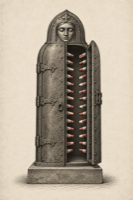
That is the iron maiden. Not the pain itself.
The door, and who is holding it.